

There comes a point every year when weddings suddenly become much better dressed. Summer, of course, has many advantages. Long evenings, outdoor ceremonies, champagne on lawns and guests wandering about in linen suits looking as though they have just stepped ashore from a yacht, despite having actually arrived in a Nissan Qashqai after forty minutes on the M4. But then September arrives. The light softens, the countryside begins turning various shades of copper, rust and gold, and the average English country house suddenly looks as though somebody has quietly increased the production budget. This is the great trick of an autumn wedding: you don’t necessarily have to do very much because nature has already started decorating the place for you.
For us as JAM Duo, autumn is one of our favourite times of year to play for weddings. That isn’t because we have anything against summer. We spend a considerable proportion of June, July and August moving a piano and cello around lawns while trying to identify which tree will provide sufficient shade without also depositing a pigeon on the Nord, and there are few things nicer than playing outside on a warm summer afternoon. But autumn has something different. It has atmosphere. The colours are richer, the clothes become more elegant, candlelight starts to make sense again and suddenly the idea of gathering inside a beautiful old building with a glass of something and some live music feels exactly right.
And atmosphere, as it turns out, is rather useful at a wedding.
Autumn Weddings Do Not Have to Mean Pumpkins
It is probably worth establishing this immediately. An autumn wedding does not require you to place a pumpkin on every available horizontal surface. Somewhere along the line, autumn wedding styling became confused with the vegetable department of a particularly enthusiastic farm shop. Pumpkins appeared by doors, underneath signs, beside table plans and, eventually, on the tables themselves. Then somebody discovered miniature pumpkins and all restraint was abandoned. There is absolutely nothing wrong with them, of course, and used sparingly they can look fantastic, particularly at a barn or country-house wedding. But there are plenty of ways to make a wedding feel autumnal without making the wedding breakfast resemble the judging tent at an agricultural show.
The real appeal of autumn styling is the extraordinary range of colours available. Burnt orange, burgundy, rust, forest green, warm taupe, copper, plum, deep red and various shades of brown suddenly become completely legitimate wedding colours. Add textured fabrics, darker foliage, natural timber and candlelight and you can create something unmistakably seasonal without having to place a squash beside every wine glass. Some of the most stylish autumn weddings we see barely acknowledge the season directly at all; they simply borrow its palette. Rust-coloured bridesmaid dresses against old Cotswold stone can look sensational, as can dark green or burgundy against woodland or autumn foliage.
Black tie also suddenly begins to make enormous sense again. In the middle of August, putting a groom and six ushers into dinner jackets at three o’clock in the afternoon can look very elegant for approximately eight minutes, after which everybody begins to develop the complexion of someone who has been accidentally locked inside a greenhouse. By October, however, darker tailoring looks completely at home. Jackets remain on, waistcoats have a purpose beyond decoration and nobody has to be revived with a damp handkerchief after the photographs. Temperature is an underrated contributor to sophistication.
Autumn Light Is Quite Possibly Cheating
Photographers have known for years that autumn has an unfair advantage. Blazing midsummer sunshine sounds perfect when written in a wedding brochure, but it can be surprisingly awkward in reality. Strong overhead sun creates hard shadows, people squint, pale dresses become extremely bright and occasionally the resulting photographs make half the wedding party look as though they are being questioned by the police. Autumn light is usually lower, warmer and softer, particularly later in the afternoon, and this can give wedding photographs that wonderful glowing quality which people then spend several hundred pounds trying to recreate with filters.
There is, however, one small administrative problem with autumn: the sun goes down. Remarkably, it does this every day, and yet it still occasionally takes people by surprise. If you are getting married later in October or November and outdoor photographs are important to you, it is worth discussing timings with your photographer before deciding that the perfect moment for couple portraits will be sometime after the speeches. A 5.30pm portrait session in late November is likely to require either floodlights or a very imaginative photographer. Earlier autumn weddings still have plenty of useful daylight, but as the season progresses you need to think slightly more carefully about how the ceremony, reception and photographs fit together.
The upside is that once that daylight begins to fade, everything else starts looking better. Candles suddenly have a point. Fairy lights become visible. Fireplaces no longer look like decorative holes in the wall, and those beautiful old rooms in country houses, barns and hotels take on an entirely different character once the windows turn dark. A wedding venue which may feel bright and airy in summer can become wonderfully intimate in autumn, and that shift in atmosphere can be one of the best parts of the day.
Being Indoors Is Not a Defeat
There is sometimes an odd assumption that an outdoor wedding is automatically superior to an indoor one. It isn’t. It is simply outside. We play for a great many outdoor ceremonies and absolutely love them, but Britain remains an island in the North Atlantic and occasionally the weather likes to remind everybody of this fact with very little notice. An indoor autumn wedding can have a warmth and intimacy that is considerably harder to achieve in midsummer: fires, candles, warm lighting, old wooden floors, stone walls and large windows looking out towards trees turning gold all contribute to an atmosphere which requires relatively little additional decoration.
There is also quite a lot to be said for a roof. It is perhaps not the most romantic sentence ever written about weddings, but roofs remain one of mankind’s better inventions. From a musical point of view, indoor spaces can also sound fabulous. Cello particularly benefits from a room with a little natural resonance, and putting Anne-Marie’s cello into a stone hall, chapel or elegant country-house drawing room can make the building itself seem to become part of the instrument. Within reason, of course. There are some very resonant churches where one chord can still be heard wandering around the rafters while we are halfway through the next piece, but a good acoustic adds depth and warmth to live music in a way that suits autumn perfectly.
This also means that couples planning an autumn wedding should not regard the indoor option merely as the emergency arrangement which nobody wants to use. If there is a choice between indoor and outdoor ceremony spaces, make sure you genuinely like both. If rain arrives on the morning of the wedding, you want the decision to move indoors to feel like a change of setting rather than the cancellation of your entire vision. Some of the loveliest ceremonies we have played have taken place indoors while rain was hitting the windows outside, and nobody cared because the room looked beautiful, everybody was comfortable and the music gave the whole thing a sense of occasion.
The Music Can Change With the Season
There is no official rule stating that wedding music must alter when the leaves change colour. If you have always wanted to walk down the aisle to A Thousand Years, it works every bit as well in October as it does in June. Nevertheless, autumn does suit certain kinds of music particularly well. Piano-led pieces, film themes, rich string arrangements and slower romantic songs seem to fit naturally into candlelit rooms and historic buildings. Pieces such as I Giorni, River Flows in You and the Glasgow Love Theme can sound wonderfully atmospheric as guests arrive, while film music can take on an almost cinematic quality when played in the right surroundings.
The advantage of live music is that it does not have to remain in one mood all day. A ceremony can begin with gentle, reflective pieces while guests take their seats, become more emotional for the bridal entrance and then completely change character once the newly married couple walks back up the aisle. The drinks reception can then become lighter and more upbeat as people relax, start talking and find the bar. Because everything we play is live, we can respond to what is happening rather than simply allowing a playlist to continue regardless of whether the room is ready for it.
This matters more than people sometimes realise. Music during a wedding should support the atmosphere rather than compete with it. If guests are sitting beside a fireplace enjoying drinks and conversation, there is no particular need to attack them with Mr Brightside. There will be plenty of time for that later, usually at around 11.47pm when several men have removed their jackets and at least one tie has migrated to somebody’s forehead. The daytime part of a wedding can have its own musical character, and autumn lends itself particularly well to warmth, elegance and a little bit of drama.
Flowers Become Much More Interesting
Summer flowers are often soft, pastel and delicate. Autumn flowers can be positively operatic. Dahlias, roses, chrysanthemums, berries, eucalyptus, trailing greenery, dried grasses and seed heads can be combined in ways which give arrangements far more depth and texture than a simple single-colour scheme. Burgundy beside blush pink looks beautiful. Rust against ivory works wonderfully. Deep reds and copper shades can transform a neutral room without needing masses of decoration.
It is often the slight imperfections in an autumn palette which make it work. The temptation with any wedding colour scheme is to decide upon one precise shade and then insist that everything from the bridesmaid dresses to the napkins and possibly the groom’s socks must match it exactly. Nature does not work like that. Look at an autumn tree and you will find yellow, orange, green, red and brown all occupying the same branch without anybody complaining that the palette has become inconsistent. Choosing a family of complementary colours usually produces a richer and more sophisticated result than attempting to match everything to one particular shade of burnt orange.
The same thinking applies to tables. Gold or brass candlesticks begin to look entirely at home, darker napkins suddenly work, wooden textures become useful and even black details can look very elegant when balanced with warmer colours. Add candles and softer lighting and you can transform even a relatively plain dining room. One of the great advantages of autumn is that the styling does not have to shout. A few carefully chosen details can be far more effective than decorating every available surface until the room resembles the seasonal aisle in a garden centre.
Have a Proper Plan for the Weather
This is perhaps the least glamorous but most useful advice of the lot. Autumn weather can change remarkably quickly. A ceremony might begin beneath blue skies and twenty minutes later the photographer is running towards the building carrying three cameras under his jacket while somebody’s table plan makes a bid for freedom across the lawn. This is not a reason to avoid autumn weddings. It is merely a reason to plan them properly.
If you are hoping to have musicians outside, make sure there is a genuine alternative available. We have encountered many gazebos over the years. Some are excellent, solid structures which provide proper shade and protection. Others appear to have been designed primarily for launching themselves into neighbouring fields. Musicians need somewhere level, stable and protected from rain, particularly when electrical equipment is involved. The fact that a cello is electric does not mean it wishes to become more electric.
At JAM Duo we carry equipment which allows us to perform in a wide variety of settings, and we have portable power options where required, but sensible protection from the weather remains essential. The best weddings are the ones where this has already been considered before we arrive. If the weather is beautiful, fantastic: everybody goes outside. If it rains, the alternative plan simply swings into action without twenty people standing in a doorway looking anxiously at three different weather apps.
Autumn Clothes Are Simply Better
There, we have said it. Autumn has better clothes. Velvet becomes possible. Tweed becomes possible. Darker suits make sense. Bridesmaids can wear richer colours which might feel too heavy in June, and wedding dresses often stand out beautifully against autumn foliage because ivory and white contrast so dramatically with darker backgrounds. For the groom and groomsmen, autumn also provides considerably more freedom to wear proper tailoring without spending the entire afternoon quietly overheating.
Guests, meanwhile, should remember that layers are useful. The phrase “outdoor drinks reception in late October” should probably prompt a little more planning than a strapless dress and blind optimism. A beautiful sunny autumn afternoon can still become surprisingly cold once the sun drops. Couples planning outdoor elements later in the season might therefore consider blankets, outdoor heaters or simply arranging the timings so guests are not left outside for too long. Nobody listens more attentively to a wedding ceremony than a guest who is gradually losing sensation in both feet.
Autumn Weddings Feel Like an Occasion
Perhaps this is the thing we like most about them. Autumn naturally makes people gather together. Summer encourages everyone to spread out across lawns, terraces and gardens, whereas autumn brings people into rooms. That creates a different sort of atmosphere: warmer, more intimate and often more sociable. A beautifully lit room full of people eating, drinking and talking while live cello and piano plays nearby somehow feels completely natural at this time of year.
There is also a sense of transition. Summer has ended, evenings are drawing in and the year is beginning to change gear. Weddings seem to benefit from this. Couples start thinking not only about how things look but about how the day will feel. What will guests experience when they arrive? What happens when the daylight fades? How does the room change between the ceremony and dinner? Where will people gather? What sort of music will suit each stage of the day? These are the questions which tend to create genuinely memorable weddings because they concern atmosphere rather than simply appearance.
And that is perhaps the best approach to an autumn wedding. Do not try to turn it into a summer wedding with colder weather. Make use of the season you actually have. Choose the richer colours, use softer lighting, embrace candles, fireplaces and textured fabrics, think carefully about the timing of photographs and have a wet-weather plan which you would genuinely be happy to use. If the sun shines and everyone spends the drinks reception outside beneath golden trees, that is a wonderful bonus. If it rains and everybody gathers inside around the bar while live music fills the room, that can be every bit as good.
Live Cello and Piano for an Autumn Wedding
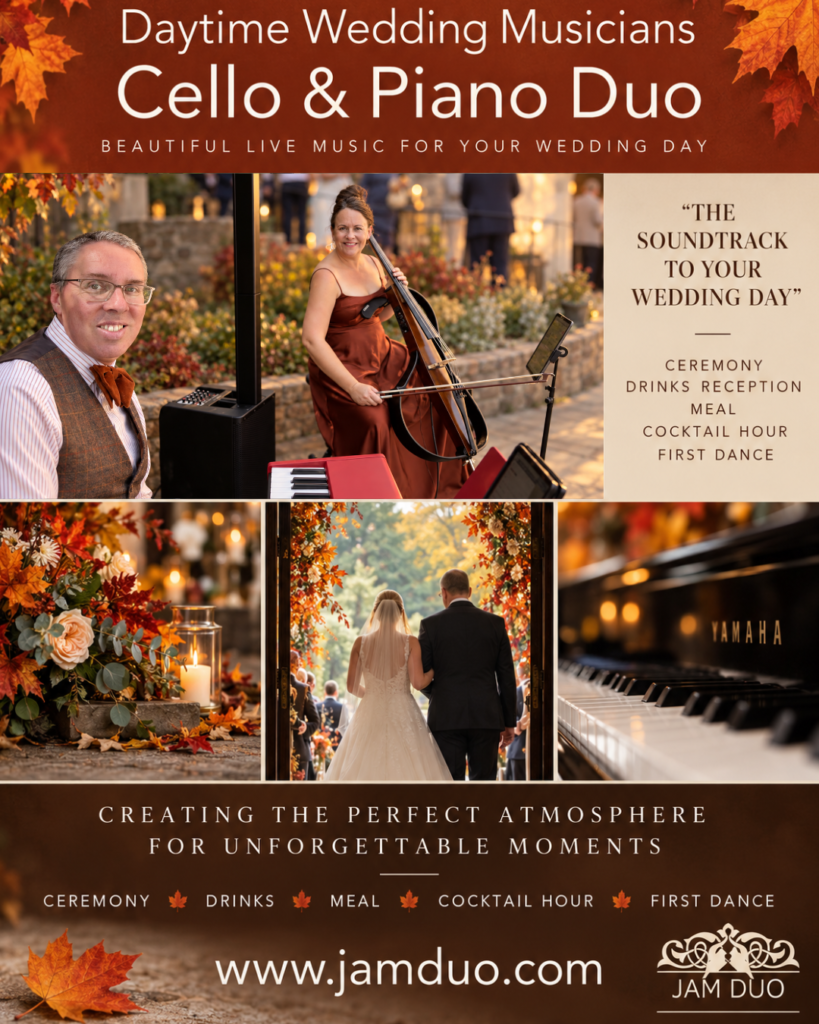
At JAM Duo we provide live cello and piano music for weddings throughout the year, from the ceremony and drinks reception through to the wedding breakfast and, for couples who want it, the first dance. Autumn gives us some particularly wonderful settings in which to do that: country houses surrounded by changing leaves, barns lit with candles, historic halls, chapels, hotels with fires burning and those glorious September afternoons when it is still warm enough to be outside but nobody is in danger of melting into the lawn.
Whatever the season, our approach remains the same. Every note is played live, there are no backing tracks and it is always the same two musicians: Anne-Marie on cello and Jules on piano. That allows us to adapt the music naturally throughout the day, respond to what is happening and make the music part of the atmosphere rather than simply something playing in the background.
Autumn can provide the colours, the softer light and the scenery, but it is usually the smaller details which determine how a wedding actually feels. The room, the lighting, the flowers, the music and the way everything flows together matter far more than whether the weather forecast displays a tiny yellow sun.
So if you are planning an autumn wedding, embrace it. Use the deeper colours. Light the candles. Take advantage of the softer light. Choose an indoor space you genuinely love. Have a proper plan for the weather and let the season do some of the decorating for you.
And if somebody does suggest placing 47 miniature pumpkins on the wedding breakfast tables, perhaps remove three.
There is such a thing as restraint.


