
When you are choosing wedding musicians, the phrase “no backing tracks” might not sontic part of the conversation. It is not quite as exciting as choosing the song for your bridal entrance, imagining your drinks reception in the sunshine, or deciding whether you would like Bridgerton, Taylor Swift, Oasis, Harry Styles, classical music or 1930s jazz during the wedding breakfast.
But it matters. In fact, it matters a great deal.
At a wedding, music is not just something that happens in the background. It has to follow real people, real timings and real emotions. The bridal party may walk more slowly than expected. A flower girl may pause halfway down the aisle. A registrar may take longer over the schedule. Guests may move from one area of the venue to another. The weather may change. Photographs may overrun. The atmosphere during the drinks reception may be calm and elegant, or suddenly lively and full of conversation.
A backing track cannot respond to any of that.
Live musicians can.
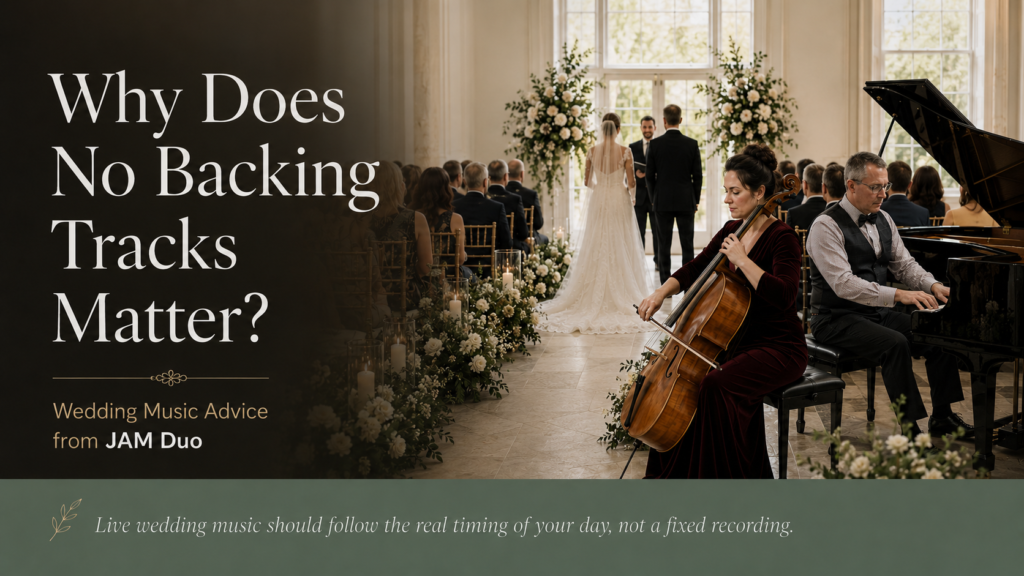
At JAM Duo, everything is performed live by Jules on piano and Anne-Marie on cello. There are no backing tracks, no pre-recorded accompaniments, no hidden tracks filling out the sound, and no laptop quietly doing half the work. What you hear is what we are playing in the room, at that moment, for your wedding.
That makes the music more natural, more flexible and much better suited to a real wedding day.
What Is a Backing Track?
A backing track is a pre-recorded piece of music that a performer plays or sings along to. It might contain drums, bass, strings, piano, guitars, harmonies or even most of the arrangement, while the live performer adds one part on top.
In some settings, backing tracks can be useful. They are common in pop performance, theatre, cabaret and some kinds of entertainment where the whole show is built around a fixed structure. But a wedding ceremony, drinks reception or wedding breakfast is very different from a staged show.
A wedding is not fixed. It does not run exactly to a script. Even when everything has been carefully planned, the timings on the day are always slightly human. People walk at different speeds. Emotional moments take time. Guests move slowly. Registrars, celebrants, photographers and venue coordinators all have their part to play.
This is where live music has a major advantage.
A backing track starts, runs for a fixed length, and stops. It does not know whether the bride has reached the front. It does not know whether the couple are still signing the schedule. It does not know whether guests are still filing outside for the drinks reception. It cannot decide to repeat a phrase, hold back, soften, extend, shorten or bring the music to a proper close.
A live musician can do all of those things instinctively.
Ceremony Music Needs Flexibility
The ceremony is the part of the wedding day where live music makes the biggest difference.
For most ceremonies, you need music for guest arrival, the bridal entrance, signing the schedule and the exit. Each of those moments has a different purpose, and each of them needs a slightly different kind of musical flexibility.
Guest arrival music sets the atmosphere before the ceremony begins. Guests may arrive early, late, all at once or gradually. A live duo can keep the music flowing naturally, choosing pieces that suit the room and adjusting the feel as the ceremony approaches.
The bridal entrance is even more important. This is one of the most emotional moments of the entire day, and it rarely fits neatly into the exact length of a recorded track. Some entrances are very short. Others involve bridesmaids, flower girls, page boys, parents, two brides, or a long walk through a church, barn, orangery, garden or country house.
With a backing track, you have to fit the entrance to the recording. With live music, the music fits the entrance.
That is a very different experience.
If the entrance takes longer than expected, we can continue naturally. If it is shorter than expected, we can bring the music to a proper ending rather than simply fading out or stopping awkwardly. If there are two separate entrances, we can move from one piece to another. If bridesmaids walk in to one song and the bride enters to another, we can make that change feel musical and elegant.
This is one of the main reasons couples choose JAM Duo for ceremony music. The cello can take the role of the vocal line, while the piano provides harmony, rhythm and shape underneath. Because both parts are being played live, the music can breathe with the moment.
The Cello Carries the Emotion
One of the reasons cello and piano work so well for wedding music is that the cello sits very close to the range of the human voice. It can sing a melody in a way that feels warm, expressive and personal, without needing lyrics.
That is especially useful at a wedding ceremony.
Many couples choose songs that mean something to them because of the words. It might be a modern love song, a piece from a film, a favourite artist, or something deeply personal from their relationship. But in the ceremony itself, an instrumental version can often feel more elegant and more intimate.
With JAM Duo, the cello often takes the vocal line. Anne-Marie plays the melody in a way that gives the song its emotional identity, while Jules shapes the piano accompaniment around it. This means you still recognise the song, but it becomes suitable for a ceremony, a drinks reception or a wedding breakfast.
When this is played live, the melody can be shaped in the moment. A phrase can linger. A cadence can settle. The music can grow as the bride enters, soften during the signing, or lift as the couple walk out together.
A backing track cannot make those musical decisions. It has already made them before the wedding even begins.
No Backing Tracks Means Every Note Is Live
When we say JAM Duo use no backing tracks, we mean exactly that.
Every note is played live by the two of us. The piano part is played by Jules. The cello part is played by Anne-Marie. There is no pre-recorded string section, no drum loop, no hidden bass line, no synthetic pad and no track running underneath to make the sound appear bigger.
This is important because it keeps the performance honest, natural and responsive.
It also means the sound you hear is the sound being created in the room. There is a connection between the musicians, the couple, the guests and the space itself. In a church, the music can use the acoustic. In a barn, it can sit warmly within the room. Outside, it can be shaped through our own sound system so it remains clear without becoming overpowering.
The result is music that feels present.
That might sound like a small distinction, but it is not. Guests can tell when music is genuinely live. They may not always be able to explain why, but they feel the difference. Live music has movement, breath and subtle variation. It responds to the room. It has energy. It has character.
A backing track will always sound the same, whether there are 20 guests or 200, whether the bride is walking down the aisle or still waiting outside, whether the signing takes two minutes or eight.
A live performance changes with the day.
Why Fixed Music Can Feel Awkward
One of the problems with backing tracks is that they are fixed.
This can create awkward moments during a wedding. If a track is too short for the bridal entrance, the music may run out before everyone has arrived. If it is too long, someone has to fade it out, cut it off, or leave it playing after the moment has clearly ended.
The same issue can happen during the signing of the schedule. Sometimes this part of the ceremony is very quick. Sometimes it takes longer because of photographs, witnesses, legal requirements or venue arrangements. A fixed recording does not know what is happening. It either ends too soon or carries on too long.
The ceremony exit can also suffer if the music is not live. This should feel joyful and celebratory. But if a track is simply started at the wrong moment, too quietly, too loudly, or without a proper musical lift, the impact can be lost.
With live musicians, these moments are much easier to manage.
We can watch what is happening and respond. We can time the start of the music properly. We can make sure the entrance feels complete. We can extend the signing music if needed. We can lift the energy for the exit and keep playing as guests begin to follow the couple out.
This is not just about musical skill. It is about wedding experience.
Having played for so many ceremonies, we understand how these moments unfold in real life. That experience is part of what you are booking.
Drinks Reception Music Should Match the Atmosphere
Backing tracks are not only limiting during the ceremony. They can also be less effective during the drinks reception.
A drinks reception is a social part of the day. Guests are chatting, enjoying drinks and canapés, congratulating the couple and often waiting while photographs are taking place. The music needs to add atmosphere without taking over.
Live cello and piano are ideal for this because the music can be elegant, upbeat, relaxed or romantic depending on the mood of the room. We can move from classical pieces to Bridgerton-style pop, from film themes to contemporary songs, from Taylor Swift to Oasis, from Harry Styles to 1930s jazz, depending on the couple’s taste and the atmosphere on the day.
A backing track is less adaptable. It brings a fixed sound, often with a fixed beat, fixed arrangement and fixed energy. That may work for a party later in the evening, but during the daytime it can feel less personal.
Live music gives the drinks reception a sense of occasion. It tells guests that this part of the day matters too. It fills the space without making it feel artificial. It gives the room warmth, style and a gentle sense of movement.
And because we are playing live, we can adjust as the drinks reception changes. If guests are quietly mingling, the music can sit more elegantly in the background. If the atmosphere becomes more upbeat, we can lift the set accordingly.
That flexibility is one of the great advantages of live music with no backing tracks.
Wedding Breakfast Music Needs Taste and Control
Music during the wedding breakfast should never feel intrusive. It should support the meal, not dominate it.
This is another area where live cello and piano work particularly well. The sound is refined, warm and elegant. It adds atmosphere while still allowing guests to talk comfortably across the table.
Backing tracks can be harder to control in this setting. Because they often contain more layers, rhythm and production, they can draw too much attention to themselves. They can also feel repetitive, especially during a long meal.
Live music has more nuance. We can choose repertoire that suits the style of the room and the energy of the guests. For a luxury country house wedding, piano cocktail jazz during the meal can feel wonderfully stylish. For a more romantic wedding breakfast, cello-led arrangements of modern songs can create a softer atmosphere. For couples who love classical music, we can keep things timeless and elegant.
The point is not simply what we play. It is how we play it.
Because there are no backing tracks, we can shape the music to the setting. We can play more gently during service, lift the atmosphere between courses, and keep the whole meal feeling polished without ever becoming too much.
Live Music Is Not Just Sound — It Is Presence
A wedding is a visual occasion as well as a musical one.
Guests notice the flowers, the outfits, the room, the table styling and the way everything has been brought together. Music is part of that presentation. A live cello and piano duo adds something elegant to the space before a note is even played.
There is a big difference between seeing two professional musicians performing live and hearing music coming from a speaker or a track. Live musicians create a focal point. They give guests something to watch and enjoy. They make the day feel more considered.
For JAM Duo, presentation is part of what we do. The cello and piano look beautiful together, and our setup is designed to suit weddings, from elegant indoor ceremonies to outdoor drinks receptions and stylish wedding breakfasts.
But the visual side only matters because the music is genuinely live. The performance is not pretending to be something it is not. The sound and the appearance match. Guests can see the cello line being played. They can see the piano part being performed. They can feel that the music is happening in front of them.
That authenticity matters.
No Backing Tracks Means More Personal Arrangements
Couples often ask whether we can play a particular song for their wedding. Very often, the answer is yes.
Because we arrange music for cello and piano, we are not limited to a fixed backing track or a pre-existing version of a song. We can take a piece of music and shape it for our instruments. That might be a classical piece, a pop song, a film theme, a Disney song, a Bridgerton-style arrangement, a jazz standard or something more unusual.
This is especially useful for ceremony music.
A song that might feel too produced, too rhythm-heavy or too pop-focused in its original version can become elegant and emotional when arranged for cello and piano. The cello can carry the vocal line, while the piano gives the harmony and structure. The result is personal, but still appropriate for the moment.
It also means we can create smooth transitions. For example, bridesmaids might enter to one piece and the bride to another. A couple may want one song for the entrance and a completely different feel for the exit. During the drinks reception, they may want a mix of classical music, modern songs and upbeat popular choices.
Because everything is live, the music can be shaped around the day rather than forced into a fixed format.
Why It Matters for the Couple
For couples, the biggest benefit of no backing tracks is peace of mind.
You do not have to worry about whether a track is long enough. You do not have to ask someone to press play at exactly the right second. You do not have to hope that a fade-out will sound natural. You do not have to fit your ceremony to a recording.
Instead, the music follows you.
That is how wedding music should feel. It should support the moment, not control it.
When you walk down the aisle, the music should feel as though it is happening with you, not simply playing over you. When you sign the schedule, the music should fill the space naturally. When you walk out together, the exit music should lift at the right moment. During the drinks reception and wedding breakfast, the music should enhance the atmosphere without feeling mechanical.
That is what live performance allows.
Why It Matters for Guests
Guests may not know whether a performer is using backing tracks. They may not use that phrase. They may not think about the technical side at all.
But they do notice how the music feels.
They notice when the bridal entrance is beautifully timed. They notice when the music continues gracefully during a delay. They notice when the drinks reception feels relaxed and elegant. They notice when the wedding breakfast has atmosphere without being noisy. They notice when musicians are genuinely performing rather than simply adding a small live part to a pre-recorded sound.
Live music gives guests a better experience because it feels part of the day.
It is not just entertainment. It is atmosphere, timing, style and emotion.
The Difference with JAM Duo
JAM Duo are a real cello and piano duo. Always Jules and Anne-Marie. Always live. No backing tracks.
This matters because we are not trying to recreate a studio recording. We are creating live music for your wedding day. That might be a romantic bridal entrance, a classical ceremony, a Bridgerton-inspired drinks reception, a set of upbeat pop songs, a stylish jazz feel during the meal, or a completely personal mix of music that reflects your taste.
The sound of cello and piano is intimate enough for a ceremony, elegant enough for a wedding breakfast and versatile enough for a drinks reception. It can be classical, modern, romantic, cinematic, joyful or relaxed.
Most importantly, it can respond.
That is the real point. Weddings are live events. They need live music.
So, Does No Backing Tracks Really Matter?
Yes. It matters because your wedding day is not a fixed recording.
It is real. It is emotional. It is unpredictable in small, human ways. The music should be able to follow that.
Backing tracks are fixed. Live musicians are flexible. Backing tracks repeat exactly what has already been recorded. Live musicians create the music in the room. Backing tracks cannot see when the bride is ready, when the signing is taking longer, when guests are moving outside, or when the atmosphere needs to lift. Live musicians can.
At JAM Duo, every note is played live on cello and piano. That gives your wedding music warmth, flexibility, elegance and authenticity.
For a ceremony, it means your entrance can be timed beautifully. For a drinks reception, it means the music can suit the atmosphere. For a wedding breakfast, it means the sound can remain stylish and controlled. Across the whole day, it means the music feels personal rather than mechanical.
That is why no backing tracks matter.
Because your wedding music should not simply be played at your wedding.
It should be part of it.