

And why live wedding music adapts while playlists don’t
When couples think about wedding music, they usually think about what they want to hear. Songs. Styles. Moments.
What’s discussed far less often is where that music will live.
The materials that make a venue beautiful — stone walls, glass roofs, timber beams, open canvas marquees — all shape how music behaves in the space. The same piece of music can feel warm and intimate in one venue, and oddly distant or overwhelming in another, even at the same volume.
Understanding this is one of the quiet advantages of live musicians who work across hundreds of weddings in very different spaces.
Sound doesn’t behave neutrally
Sound is physical. It reflects, absorbs, spreads and decays depending on what it touches.
A venue isn’t just a backdrop — it’s an active participant in how music is experienced. And because weddings move between multiple spaces (ceremony room, drinks area, dining space, evening room), the acoustic character often changes several times across the day.
Live musicians adapt instinctively. Recorded music cannot.
Stone venues: warmth, weight and resonance
Stone churches, manor houses and historic barns are some of the most popular wedding venues — and for good reason. They feel grounded, timeless and emotionally weighty.
Acoustically, stone:
- Reflects sound strongly
- Allows notes to linger in the air
- Adds natural resonance and depth
This is why music in stone spaces often feels bigger than it actually is.

The challenge is control. Too much sound can quickly blur detail, especially with recorded tracks where dynamics are fixed. Live musicians can respond by:
- Playing with lighter articulation
- Allowing space between phrases
- Letting the room do some of the work
In stone venues, less is often more. Well-judged live music feels expansive without ever becoming overpowering.
Glass venues: clarity with consequences
Modern venues with glass walls, ceilings or atriums are visually stunning. They let light flood in and create a sense of openness.
Acoustically, glass:
- Reflects sound sharply
- Creates brightness and clarity
- Can exaggerate high frequencies
This can make music feel very present — sometimes too present.

Recorded music in glass-heavy spaces often feels harsher than expected, even at modest volume. Live musicians instinctively soften tone, adjust touch and rebalance dynamics so the sound remains elegant rather than brittle.
In these venues, musical sensitivity matters more than volume control.
Barn venues: character with unpredictability
Barns are acoustically fascinating because no two are the same.
Timber beams, open ceilings, brick, stone, plaster and soft furnishings all interact differently. Some barns absorb sound beautifully; others throw it around in surprising ways.

What barns tend to share is:
- A sense of warmth and intimacy
- A mix of reflective and absorbent surfaces
- An acoustic that changes as the room fills with people
As guests arrive, sound becomes softer and more contained. Live musicians feel this shift and adjust naturally — changing touch, tempo and balance as the room settles.
This is one of the reasons live music works so well in barn venues: it moves with the room.
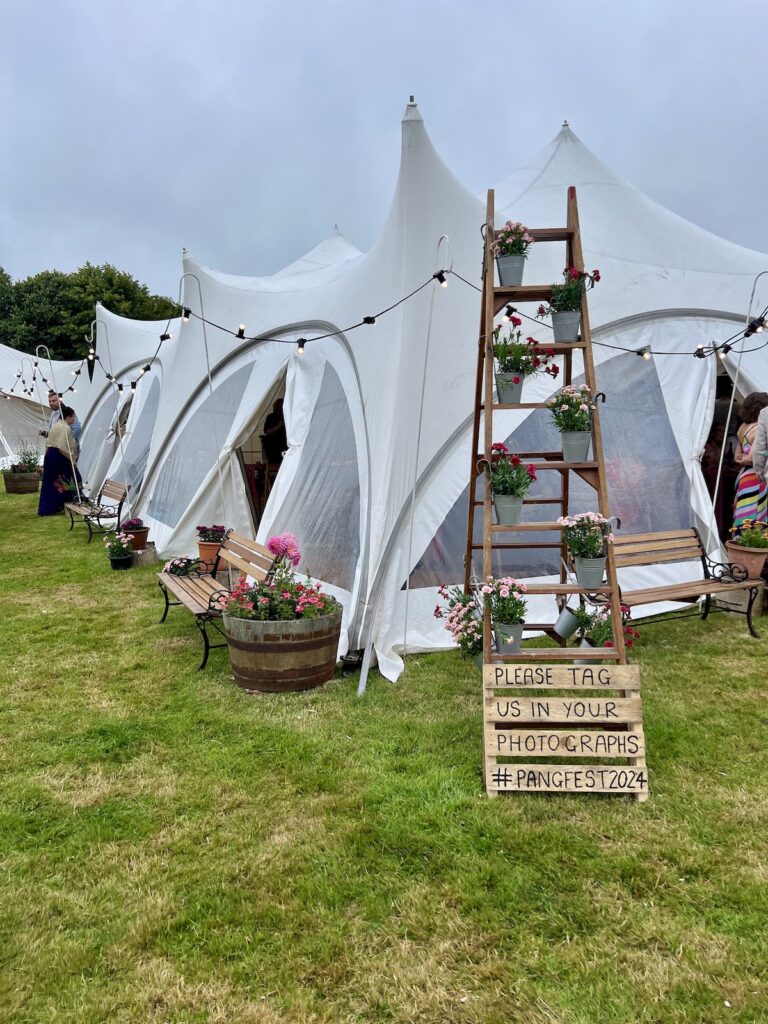
Marquees: openness and exposure
Marquees are often the most misunderstood acoustically.
They look enclosed, but in sound terms they are not. Canvas absorbs very little, and open sides or gaps allow sound to escape rather than reflect.
This means:
- Music dissipates quickly
- Sound can feel thinner than expected
- Volume alone doesn’t create warmth
Recorded music in marquees often ends up louder than intended in an attempt to compensate — which can feel intrusive rather than atmospheric.
Live musicians adapt by:
- Playing more connected, sustained lines
- Shaping phrases to carry naturally
- Creating presence without forcing volume
In marquees, musical intention matters more than amplification.

Why live music adapts and recordings don’t
Recorded music is fixed. Its balance, tone and dynamics were designed for headphones or speakers in controlled environments — not for historic stone walls or open countryside.
Live musicians, by contrast:
- Respond to the room in real time
- Adjust to guest noise and movement
- Change dynamics without anyone noticing
- Follow the atmosphere rather than a timeline
This is why live music often feels “right” even when guests can’t explain why. It belongs to the space because it’s shaped by it.
What couples often notice — without realising why
Couples frequently tell us things like:
- “It just felt comfortable.”
- “It didn’t feel loud, but it filled the space.”
- “People stayed and chatted longer.”
These reactions are rarely about repertoire. They’re about acoustic ease — music sitting naturally in the room instead of fighting it.
Good live music doesn’t announce itself. It supports the environment.
One venue, multiple acoustic personalities
A single wedding day might include:
- A stone ceremony room
- A glass-walled drinks area
- A timber dining barn
- A marquee for the evening
Each space requires a different musical approach.
Live musicians move between these environments instinctively. We don’t play the same way in every room, even if the piece is the same. The venue tells us what it needs.
That’s something no playlist can do.
Why this matters more than people think
Music that doesn’t suit a space isn’t always obviously “wrong” — it just feels slightly uncomfortable. Conversations strain. Energy dips. Moments don’t quite land.
When music fits the space:
- Guests relax more quickly
- Transitions feel smoother
- The day feels calmer and more cohesive
It’s one of the quiet foundations of a wedding that feels effortless.
JAM Duo and working with real spaces
At JAM Duo, we perform in stone churches, glass-fronted venues, rustic barns and open marquees every week of the year. Our approach is never to impose sound on a space, but to work with it.
Live piano and cello give us the flexibility to:
- Shape sound to the room
- Adjust naturally as spaces fill or empty
- Create atmosphere without escalation
- Support conversation as much as celebration
Venues change sound. Live music changes with them.
That’s why it works.