

There’s a quiet assumption that more musicians automatically means a better musical experience.
It’s an understandable idea. More sound, more presence, more “performance.” But in practice, particularly at weddings, the opposite is often true.
At JAM Duo, we’ve built everything around a simple principle: two musicians, working seamlessly together, will always create a more refined, more controlled, and ultimately more meaningful atmosphere than a larger, loosely assembled group.
That isn’t about keeping things small for the sake of it. It’s about maintaining a standard.
A Duo, Not a Line-Up
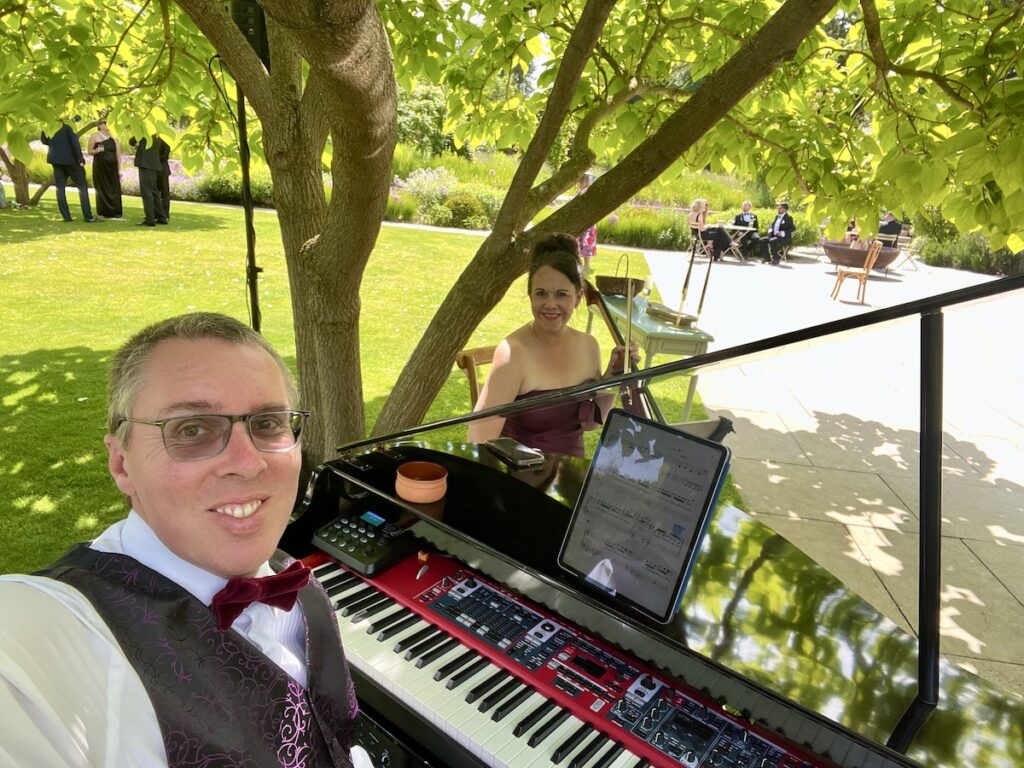
From the very beginning, JAM Duo has never been a “collective” or a rotating group of musicians. It has always been Jules on piano and Anne-Marie on cello — working together, refining together, performing together.
That consistency matters far more than most couples realise.
When you book a larger ensemble or a flexible group, you’re often booking a format, not a specific musical relationship. The players may be excellent individually, but they may not have worked together regularly — or at all. Rehearsal time is limited, and what you hear on the day is often the first real attempt at cohesion.
With a duo that performs together week in, week out, that uncertainty simply doesn’t exist.
We know exactly how each other plays.
We know how a phrase will breathe before it happens.
We know when to hold back, when to lead, when to reshape a moment in real time.
We don’t need to think about balance, tempo, or timing — it’s instinctive.
That level of connection can’t be assembled. It has to be built over time.


The Difference You Can Hear (Even If You Don’t Realise It)
Most guests won’t consciously analyse the music at a wedding. They won’t be thinking about voicing, harmonic movement, or phrasing.
But they will feel when something is right — and equally, when something is slightly off.
A duo that works regularly together creates:
- Consistent timing — no dragging, no rushing
- Balanced sound — neither instrument overpowering the other
- Clean transitions — between sections, between songs, between moments
- Confidence in delivery — the music supports the day rather than competing with it
These things are subtle. But they’re what allow the music to sit naturally within the atmosphere of the day, rather than drawing attention for the wrong reasons.
Why We Keep It Just the Two of Us
We’re occasionally asked whether we can add other musicians — perhaps a singer, a guitarist, or a small ensemble.
And the honest answer is that, in most cases, we choose not to.
That’s not because we don’t value other musicians. Far from it. We’ve worked alongside many excellent performers over the years.
But we’ve also seen the other side.
When you introduce additional musicians into a setup that isn’t regularly rehearsed as a unit, you introduce variables:
- Differences in timing and musical interpretation
- Variations in technical ability
- Unpredictable balance and blend
- A lack of shared musical instinct
Even small inconsistencies can affect the overall feel.
We’ve encountered situations where, for example, a singer or guitarist hasn’t quite had control of their harmony or structure — playing incorrect chords, misjudging phrasing, or losing the shape of the piece. For some, that may pass unnoticed. But for us, those details matter.
They matter because they affect the emotional integrity of the moment.
And once that standard drops, even slightly, it’s very difficult to recover the same level of polish.
Control, Responsibility, and Standards
By working as a fixed duo, we retain complete control over what we deliver.
Every arrangement is crafted by us.
Every transition is considered.
Every performance is something we’ve played, refined, and lived with over time.
There’s no uncertainty about who is turning up, how they will perform, or how the music will come together on the day.
That consistency allows us to guarantee a level of quality that simply isn’t possible when relying on external musicians whose approach, preparation, or standards may differ.
It’s not about perfection in a rigid sense. It’s about reliability — knowing that the music will support the day exactly as it should.
The Exception: Supporting a Special Moment
There are, of course, occasions where a couple would like to include a personal performance — perhaps a bride singing during the drinks reception, or a bridesmaid offering a song as part of the day.
These moments are often incredibly meaningful, and when approached thoughtfully, they can be a lovely addition.
In those situations, Jules is always happy to provide piano accompaniment.
But even here, the approach remains the same: simple, supportive, and carefully handled.
We don’t turn it into a “feature performance” with additional layers or complexity. Instead, we provide a stable musical foundation that allows the moment to feel natural and personal, without introducing unnecessary risk.
It’s a subtle difference, but an important one.
Why Less Often Feels Like More
One of the most common pieces of feedback we hear is that the music felt “effortless.”
That’s not accidental.
A well-matched duo doesn’t need to fill every space. It doesn’t need to be louder, bigger, or more attention-grabbing.
Instead, it:
- Shapes the atmosphere without overwhelming it
- Allows conversation to flow naturally
- Supports key moments with clarity and control
- Adapts instantly to what’s happening in the room
In many ways, the restraint is what makes it effective.
Experience Brings Perspective
Having worked at hundreds of weddings, we’ve seen a huge range of musical setups.
Some are excellent — thoughtful, well-rehearsed, and carefully delivered.
Others, if we’re being honest, are less so.
It’s not always about obvious mistakes. Often it’s something more subtle:
- A lack of cohesion between players
- Slight timing inconsistencies
- Unbalanced sound
- Overcomplicated arrangements that don’t quite settle
Individually, these things might seem minor. But collectively, they shape the overall experience.
Over time, you develop a very clear understanding of what works — and what doesn’t.
For us, the conclusion has always been the same: a dedicated, well-rehearsed duo will outperform a loosely assembled group almost every time.
A Quiet Confidence
There’s a certain confidence that comes from knowing exactly what you do, and doing it well.
We don’t try to be everything.
We don’t offer multiple line-ups or constantly changing formats.
We focus on one thing — delivering refined, live music as a piano and cello duo — and we do it consistently, across every wedding.
That clarity allows us to concentrate fully on the details that matter:
- The flow of the ceremony
- The atmosphere of the drinks reception
- The pacing of the day as it unfolds
Because we’re not managing additional musicians or adapting to unfamiliar setups, we’re free to focus entirely on the music itself.
The Result on the Day
What this ultimately creates is a sense of ease.
For the couple, there’s no uncertainty.
For the planner, there’s no need to coordinate multiple performers.
For the guests, the music simply works.
It supports the day without distraction. It enhances the atmosphere without overpowering it. And it does so with a level of consistency that only comes from two musicians who know exactly how to play together.
Always Live, Always Us
At its core, this is what JAM Duo is about.
Two musicians.
One shared approach.
A consistent standard.
We take pride in that simplicity — not because it’s easy, but because it allows us to deliver something dependable, refined, and quietly confident.
And in a setting where every detail matters, that consistency is often what makes the difference.