

Wedding Planning Advice from JAM Duo
There are plenty of things to consider when planning a wedding. Flowers, photographers, seating plans, table decorations and, of course, what everyone is going to eat. But somewhere towards the bottom of the list, usually after you’ve worked out whether Aunt Margaret can reasonably be seated next to Uncle David, comes another question: do we need to feed our wedding suppliers?
It’s a perfectly reasonable question, and one which deserves a rather more useful answer than the familiar wedding industry suggestion that anyone working at your wedding should automatically be provided with a hot meal.
At JAM Duo, we have a very simple approach. We never require our couples to provide us with food or drinks. When we’re booked to play from the ceremony through to the wedding breakfast, or for an even longer part of the day, we do invite couples to consider a supplier meal. But this is entirely optional. We understand that weddings are expensive enough without adding another two meals to the catering bill.
We are always extremely grateful when couples do include us. However, there are a few things worth knowing about supplier meals, particularly what you’re actually getting for your money.
Why Do Wedding Suppliers Appreciate a Meal?
To understand why we mention supplier meals at all, it helps to consider what a typical wedding day looks like from our side of the piano.
Let’s imagine you’re getting married at 1pm. We will generally need to arrive at your venue by around 11.30am to unload our instruments, find the appropriate performance areas, set up and make sure everything is ready well before your guests arrive.
Depending on where your wedding is taking place, we might have left home at 6am, 7am or perhaps 8am. We travel extensively throughout England, Wales and Scotland, and an early start is very much part of the job.
By 1pm we’re playing for your ceremony. At 1.30pm we’re providing the music for your drinks reception, and by 3.30pm we’re preparing for the wedding breakfast. There will usually be some moving of instruments and equipment along the way, sometimes between different rooms or even different buildings.
By this point, we may have been at work for several hours without a proper opportunity to sit down, have something to eat or even enjoy a drink.
And there is a rather important practical consideration: we can’t exactly sit at the piano eating a packed lunch while your guests enjoy their champagne and canapés.
We do, of course, come prepared. A flask of coffee or a bottle of water is a regular travelling companion, and we always make whatever arrangements we reasonably can. But when we’re performing throughout the afternoon, there aren’t necessarily opportunities to disappear for half an hour in search of lunch.
This is why a supplier meal, or simply the opportunity to have something to drink, can be so welcome.
Even a Glass of Water Isn’t Always Guaranteed
One of the more surprising things we’ve discovered over the years is that wedding venues don’t necessarily offer suppliers any refreshments at all.
We have performed at some wonderful venues where the staff couldn’t be more accommodating. Someone will appear with a jug of water, ask whether we’d like a coffee or simply make sure we have everything we need. It’s a small gesture, but one which makes an enormous difference.
At other venues, however, we can spend several hours playing without anyone offering so much as a glass of water.
That’s not to say we couldn’t ask. Of course we could. But when you’re in the middle of a wedding ceremony or playing continuously during a drinks reception, finding a member of staff and asking for refreshments is sometimes easier said than done.
We certainly don’t expect to be wandering around with trays of champagne. A glass of tap water would be absolutely splendid.
This is one reason we’re particularly grateful when couples arrange for their suppliers to have access to soft drinks or water. It’s not about expecting special treatment. It’s simply about making it a little easier for the people working at your wedding to do their jobs comfortably.
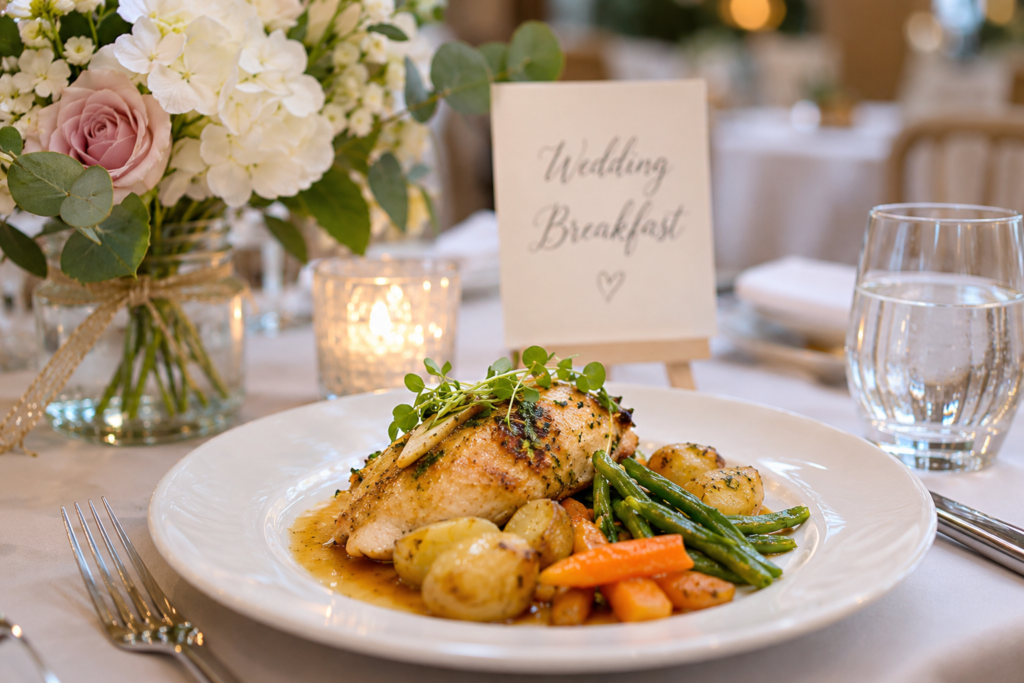
The Curious Economics of Wedding Supplier Meals
Now we come to something we think every couple should consider before agreeing to pay for supplier meals.
What exactly is your venue charging you, and what are you getting for that money?
In our experience, at most weddings where we’re provided with a supplier meal, we’re served the same main course as the wedding guests. And that’s absolutely lovely. We certainly don’t need the starter, dessert, wine or anything else that comes with the full wedding breakfast. A main course is more than sufficient, and we’re always grateful for it.
But here’s where things become interesting.
Your guests might be enjoying a three-course wedding breakfast, complete with drinks and all the associated service. As suppliers, we’re generally given just the main course, often served separately and rather more informally.
So presumably the supplier meal costs significantly less?
Well, you’d certainly hope so.
We have absolutely no objection to venues charging for supplier meals. Food costs money, chefs need paying and somebody has to wash up afterwards. But if a supplier is receiving only one course of a three-course meal, without drinks or the full table service, it seems perfectly reasonable that the price should reflect that.
If your venue offers a supplier meal at a substantial reduction compared with the price of the full wedding breakfast, that’s entirely fair.
But if they’re charging you almost as much for one course as they’re charging for the entire wedding breakfast, it’s worth asking why.
We don’t generally know what our couples have been charged for our meals, and we certainly wouldn’t dream of asking. But we’d encourage anyone planning a wedding to check the figures before simply adding supplier meals to their catering package.
And here’s another thought. We’re perfectly happy with a sandwich and a packet of crisps. We don’t need the same carefully presented main course that you’ve chosen for your guests.
If your venue charges a surprisingly high price for supplier meals, why not ask whether there’s a simpler, more economical option?
The object, after all, is to make sure the people working at your wedding can have something to eat. It isn’t to provide the venue with another opportunity to charge wedding prices for something that needn’t be complicated.
Five Questions Worth Asking Your Wedding Venue
If your photographer, videographer, musicians or other suppliers have mentioned meals, here are a few sensible questions to put to your venue before agreeing to anything.
- What does the supplier meal actually include? Is it the same main course as the wedding guests, or something different?
- How much does it cost per person? Check whether the quoted price includes VAT and any additional service charges.
- Are drinks included? Even if you’re not providing food, can your suppliers access drinking water or soft drinks?
- When and where will the meals be served? Suppliers may have very limited breaks, and timing is often more important than the menu.
- Can we provide something simpler? If the venue’s supplier meal is particularly expensive, ask whether a sandwich, packed lunch or other straightforward alternative would be possible.
It’s also worth checking whether your suppliers actually need a meal. Someone who’s attending for just an hour or two is in a rather different position from a photographer who has been working since the bridal preparations or musicians providing entertainment throughout the afternoon and evening.
You may find that some suppliers have meals written into their contracts, while others, like JAM Duo, simply leave the decision to you.
A Little Consideration Goes a Long Way
Weddings are unusual working environments. Most people can take a lunch break, make a cup of tea or pop out to buy something to eat. Wedding suppliers often have to organise their day around a schedule which cannot easily be interrupted.
If the bride is about to walk down the aisle, we can’t announce that we’ve gone in search of a sandwich.
Similarly, a photographer can’t reasonably disappear halfway through the speeches because it’s lunchtime.
Of course, experienced wedding professionals understand this and plan accordingly. It’s part of the job. But a little consideration from the couple or the venue can make the day considerably more comfortable for everyone involved.
And it needn’t involve spending lots of money.
Sometimes simply asking the venue to make sure suppliers have access to drinking water is a thoughtful and genuinely useful gesture.
Our Approach at JAM Duo
We perform at around 200 weddings each year, and our bookings range from ceremony-only performances to providing live music throughout much of the wedding day.
When we’re playing for the ceremony, drinks reception and wedding breakfast, we may be working at the venue for six hours or more, quite apart from the travelling and preparation involved.
We therefore mention supplier meals as an option when couples book us for an extended period. But there is absolutely no obligation to provide one, and we would never want anyone to feel pressured into spending money on our behalf.
If you do choose to provide something, thank you. We genuinely appreciate it.
If you don’t, that’s absolutely fine too. We’ll still arrive in good time, set everything up properly and give your wedding exactly the same care and attention.
Our one piece of advice is simply this: before agreeing to pay for supplier meals, ask your venue what they actually provide.
A supplier meal needn’t be elaborate, and it certainly shouldn’t become another unnecessary wedding expense.
Sometimes a sandwich, a packet of crisps and a glass of water are all that’s needed to make two musicians very happy.
And if you’ve booked us to play at your wedding, we’d much rather your money went towards something you’ll actually remember. After all, the chances of your guests talking about the cellist’s jacket potato in twenty years’ time are fairly remote.