

No backing tracks. No artificial performances. Just two musicians, two instruments and music played live.
We live in a rather peculiar world.
Photographs can be improved until the people in them bear only a passing resemblance to the originals. Videos can show people saying things they never said. Artificial intelligence can write poetry, compose music, invent photographs and, apparently, provide the answer to almost anything, whether it knows the answer or not.
Meanwhile, Spotify will happily provide several million recordings at the touch of a button, algorithms decide what we ought to listen to next, and social media presents a carefully polished version of reality in which nobody ever has a bad hair day, an untidy kitchen or an unsuccessful holiday.
It’s all terribly clever. But occasionally it’s rather nice to encounter something that is exactly what it claims to be.
Which brings us to two people with a cello and a piano.
Music Without the Smoke and Mirrors
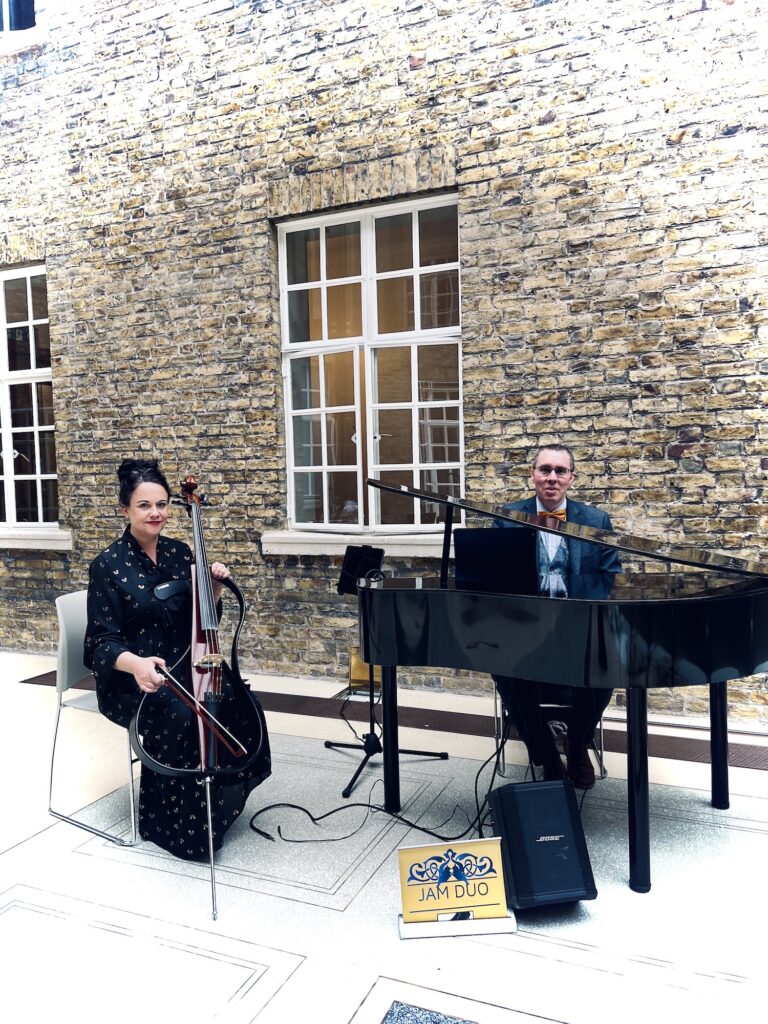
At JAM Duo, we have a fairly straightforward approach to making music. Anne-Marie plays the cello. Jules plays the piano. And between us, we make the music you hear.
That’s it.
There are no backing tracks providing an invisible orchestra. No pre-recorded accompaniments filling in the gaps. No computer-generated musicians lurking somewhere in the background. When we perform at a wedding, every note is being played by one of us, there and then.
It seems slightly absurd that this should be something worth pointing out. After all, there was a time when the phrase ‘live music’ was reasonably self-explanatory.
Today, however, technology makes it possible to produce remarkably convincing performances with relatively little actual performing involved. A keyboard can reproduce an entire string orchestra, a laptop can provide a rhythm section, and a prerecorded track can make two people sound like twenty.
There is nothing inherently wrong with any of that. Technology has opened up extraordinary possibilities for musicians and performers, and there are circumstances where backing tracks make perfect sense.
But we happen to believe there’s something worth preserving about two musicians who can sit down, look at one another and simply play.
The Beauty of Something That Isn’t Manufactured
One of the interesting things about live music is that it never happens in quite the same way twice.
We might have played Pachelbel’s Canon hundreds of times, but the performance at your wedding will still be unique. The tempo might breathe slightly differently. One phrase might be held just a little longer. Anne-Marie might respond to something Jules does at the piano, or the piano might follow a subtle change in the cello.
These aren’t mistakes or inconsistencies. They’re part of the conversation that takes place between musicians.
It’s the same reason a live orchestra is more interesting than listening to a recording of one, or why people still travel considerable distances to hear their favourite artists perform music they could quite happily play through their headphones at home.
There’s a human element that simply cannot be replicated by pressing play.
And at a wedding, that matters rather more than you might imagine.
Your Wedding Isn’t a Recording
Consider the bridal entrance.
It’s one of the most anticipated moments of the entire day. Everyone stands, the doors open and suddenly months, sometimes years, of planning become something very real indeed.
Now imagine that moment being accompanied by a recording.
The music starts. It continues at precisely the speed it was recorded. If the bride takes longer than expected to reach the front, the recording doesn’t know. If the doors open a few seconds later than planned, the recording doesn’t care. It simply carries on, blissfully unaware of anything happening around it.
Live musicians, on the other hand, are watching.
We can allow the introduction to continue until everyone is ready. We can adjust the pace to suit the entrance, extend a musical phrase or bring the piece to a natural conclusion at precisely the right moment.
And we can do all of this without anyone noticing that an adjustment has been made.
That’s rather the point.
The best musical accompaniment doesn’t demand attention for itself. It becomes part of the occasion, responding naturally to what is happening.
It’s one of the reasons we place such importance on being musicians first and wedding suppliers second. The ability to play an instrument is one thing. The experience to accompany an important occasion sensitively is something else altogether.
We’re Not Against Technology. Far From It.
Of course, it would be rather hypocritical to suggest that we’re somehow operating entirely without modern technology.
Our stage piano is electronic. Anne-Marie regularly plays an electric cello. We have amplification, recording equipment and a website containing hundreds of examples of our music. Indeed, you’re probably reading this on a device which would have seemed like science fiction thirty years ago.
We also make extensive use of technology when arranging, recording and sharing our music.
But there’s an important distinction.
Technology can help us deliver a performance. It doesn’t have to create the performance for us.
When Jules plays our Nord piano, every note is still played on the keyboard. When Anne-Marie uses her Yamaha electric cello, she’s still playing a real cello with a bow, producing the notes and shaping the phrases herself.
The instruments may be modern, but the musicianship is exactly the same.
Our recordings are made in our own studio, with the two of us actually playing the music. We don’t use AI to manufacture performances or backing tracks to make ourselves sound like a larger ensemble.
What you hear on our website is intended to demonstrate what we can actually do.
And that’s exactly what you’ll hear at your wedding.
Perhaps Perfection Is Overrated
There’s something rather strange about the modern pursuit of perfection.
We can now remove almost every blemish from a photograph, correct the pitch of a singer, adjust the timing of a musical performance and polish a recording until every note sits precisely where a computer thinks it ought to be.
The result can be technically immaculate.
But technical perfection and musical expression aren’t necessarily the same thing.
Sometimes the most beautiful moment in a performance is a phrase that lingers slightly longer than expected, a particularly expressive cello note or a subtle change of tempo that neither musician had consciously planned.
These are the things that happen when musicians listen to one another rather than follow a machine.
Of course, we aim to play accurately. Nobody wants a wedding ceremony accompanied by an experimental interpretation of the wrong notes. But accuracy is only part of musicianship, and music would be a rather dull business if every performance sounded identical.
The best performances have personality. They have warmth. They have a sense of occasion.
Above all, they have people behind them.
Keeping It Real for the Moments That Matter
We don’t pretend that live music will change the world. Nor do we believe there’s anything particularly noble about refusing to use a backing track.
It’s simply how we prefer to work.
After years of performing together, we know how to follow one another, how to adapt to a room and how to provide music that feels entirely natural within a wedding day.
Sometimes that means a carefully timed bridal entrance. Sometimes it’s a lively piece during the drinks reception, or something quieter while guests enjoy their meal. Occasionally it’s a spontaneous request that sends us in a musical direction neither of us had anticipated that morning.
Whatever the occasion, the principle remains the same.
Two musicians. Two instruments. Real music.
In a world where almost anything can be digitally created, altered or convincingly faked, perhaps there’s something rather reassuring about that.
No backing tracks. No AI-generated performances. No pretending to be something we’re not.
Just live music, played live.
And when the moment matters, we think that’s worth something.


